Why Does My Dog Guard the Couch and Furniture? A Vet's Guide
A veterinarian explains couch guarding in dogs, what stiffening and growling mean, and how to rebuild safe sharing without confrontation.
Your dog guards the couch because it feels safe and valuable, not because he is trying to dominate you.
A 4-year-old, 68-pound mixed-breed dog naps stretched across the middle cushion every afternoon, and for three weeks in a row he has stiffened when his owner sits down beside him. At first it was a hard stare and a closed mouth. Then a low growl when a hand reached for the remote. The owner worried she had a dominance problem on her hands, and she was weighing whether to start shoving him off to prove a point. That choice — confront the growl or change the setup that creates it — is the decision that shapes everything else with furniture guarding.
Resource guarding is normal dog behavior with a simple mechanism. Access to a comfortable, warm, high-value resting place triggers arousal and retention behavior wired through the limbic system, and learning does the rest. If stiffening or growling has successfully kept people away before, the brain remembers that sequence. Stress, fatigue, inconsistent rules, and pain lower the threshold for the next episode. Your dog is not plotting status. He is protecting sleep and comfort in the one spot that predicts both.
What guarding actually looks like on the couch
Early signs are easy to miss if you expect only snarling.
The quiet signals before the growl
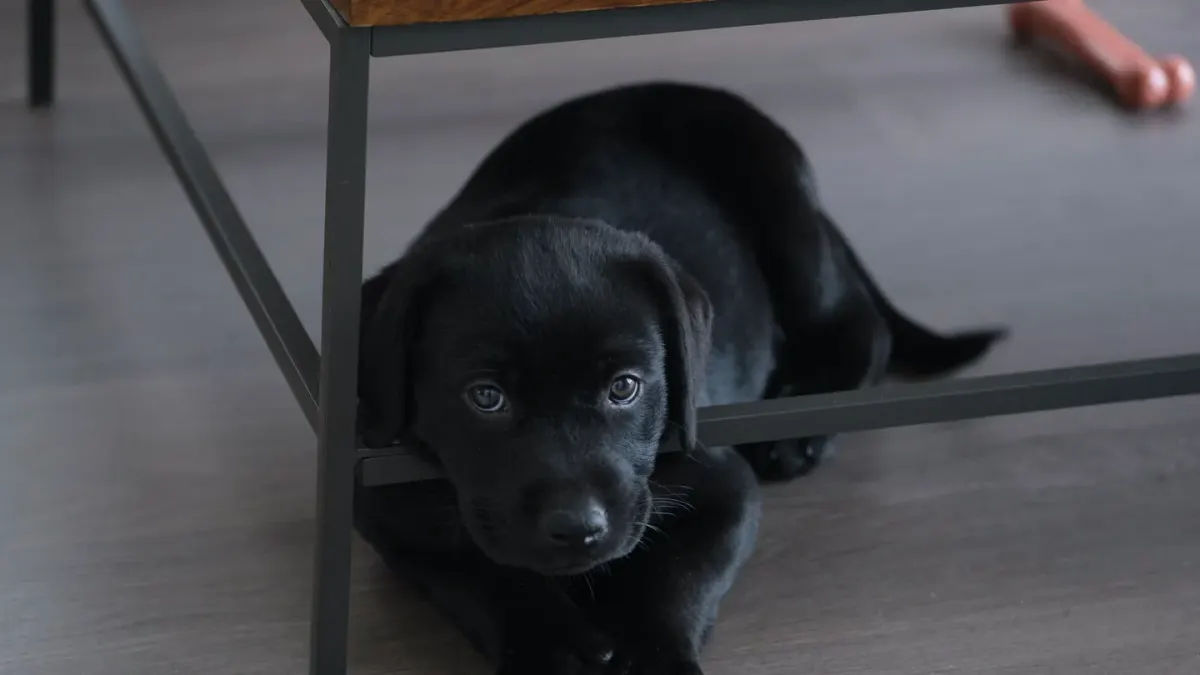
Watch for freezing over a chew on the couch, eating faster when you approach, a hard sideways glance called whale eye, ears pinned forward and body weight shifted over the cushion, or moving to block you with a shoulder. A dog who slides under the coffee table or behind the armchair to keep the space may be choosing distance before conflict.
A single short paragraph matters here: A growl is information, not disrespect.
If you punish the growl, many dogs learn to skip the warning and go straight to a snap. You can read more about that warning system in Why Does My Dog Growl When I Pet Him? A Vet’s Guide to Reading the Warning and What Does It Mean When My Dog Growls at Me?.
Why the couch becomes worth guarding
Value plus predictability creates guarding. The couch smells like family, it is soft and elevated, and it is where treats and petting often happen. Add rehearsal — the dog practices the same standoff every evening — and the pattern firms up. Changes in the home, less exercise, irregular sleep, or being repeatedly surprised while resting make it worse.
Pain deserves special attention. Arthritis, skin irritation, ear infection, or gastrointestinal discomfort can turn a tolerant dog into a dog who guards the exact spot where he finally got comfortable. A baseline veterinary exam matters before you label anything behavioral, especially for a new onset in an adult dog.
A 2-year-old, 45-pound herding mix lived with a no-couch rule that no one enforced. For ten days his owners tried the opposite of management: they pulled his collar to drag him off, chased him when he ran behind the sofa, and scolded the growl. By day 10 he stopped growling and started snapping at hands near the armrest, and the couple felt less safe than when they started. The tradeoff was clear in hindsight. Force suppressed the signal without lowering the value of the couch, and it taught him that people near furniture were unpredictable. They had to pause all confrontation and rebuild from management before any training could stick.

My recommendation: manage first, then teach sharing
My position as a clinician is consistent: prevent rehearsal with management first, then teach a cheerful off-cue and trade-up pattern with food. I land here because it lowers bite risk while you retrain the emotion underneath, and it works without intimidation.
The strongest counterargument is that management feels like giving in, and that the dog should learn to obey off no matter what. I understand that frustration. Obedience alone still leaves a dog who feels tense about people approaching his resting place, and tension is what drives escalation. A dog who hops off happily for a scatter of kibble because the routine is predictable is safer than a dog who hops off because he is afraid of being grabbed.
What to do today without a confrontation
Stop testing the growl. Your短期 goal is zero standoffs for the next two weeks.
Block access when you cannot supervise with a folded blanket over cushions, an overturned laundry basket on the favorite seat, a baby gate, or a closed door. Give the dog a genuinely good alternative in the same room: a thick orthopedic bed, a crate with the door open, or a mat with a long-lasting chew. Feed meals and special chews only on that spot so it gains value.
Teach off as a paid invitation, not a correction. Toss a handful of small treats to the bed, say off once as he steps down to follow them, then reward on the bed. Practice five short reps at calm times of day, not mid-growl. If he is already on the couch and stiff, call him from a distance with a happy voice and reward the dismount rather than reaching for his collar.
Build approach into good news. Walk past at a distance where he stays relaxed and toss a treat behind him so he learns your movement predicts extra, not loss. Shrink distance gradually over days. Keep kids off the couch with the dog entirely during retraining, and do not corner a dog who retreats under furniture.
Daily levers matter more than any quick fix. A sniffy walk, predictable rest, and a consistent evening routine may help support lower baseline arousal. Sleep-deprived, under-exercised dogs guard more readily, and no training plan overcomes chronic overtiredness.
Where calming ingredients fit, and where the evidence is thin
Owners often ask about chamomile, valerian, ashwagandha, or L-theanine for a tense guarder. I keep expectations preventive and narrow here because the direct evidence for resource guarding in dogs is limited.
For context on evidence quality, a MDPI Biomedicines review notes that “For the remaining species, evidence is derived mainly from preclinical studies or traditional use.” That same traditional-use category includes the observation that “Chamomile and Valerian Root have been used in traditional herbal care to support relaxation.” A Cureus systematic review found that “A systematic review analyzed multiple RCTs and concluded that ashwagandha has a moderate positive impact on stress reduction and cognitive performance.” For L-theanine, a Nature Molecular Psychiatry review reports “except for one study on psychotic anxiety (SMD = 0.54; 400 mg/day for 8 weeks)” — a human dose finding, not a canine guarding protocol.
In plain terms, “L-theanine is an amino acid found in tea that has been studied for its calming properties,” and “Contains KSM-66 Ashwagandha, a clinically studied form of Ashwagandha for stress support.” Those structure/function ideas may help support general relaxation alongside training, but they do not replace management, pain evaluation, and teaching a trade-up response. Talk with your veterinarian before starting any supplement, especially for dogs on behavior medications or with liver disease.
A 9-year-old, 24-pound terrier mix showed the edge case I watch for in practice. She had slept on an armchair for years without issue, then over three weeks began guarding the space underneath it and yelped when lifted down. The owner assumed new stubbornness and considered stricter rules. On exam the change tracked to stiff hips and a sore back that made jumping down painful, so the chair had become both bedroom and trap. Once the veterinarian addressed pain, added steps to the preferred bed, and the family stopped lifting her mid-sleep, the evening growls faded. Guarding that appears late in life or under furniture deserves a pain-first look.
When to get professional help
Call your veterinarian promptly for new, intense, or escalating guarding, any bite or snap that connects, guarding that generalizes to doorways, food bowls, or people, or guarding paired with limping, appetite change, or sensitivity to touch. A veterinary behaviorist or certified applied animal behaviorist can design a desensitization plan if management alone is not enough. You can also compare notes on arousal at home in Why Does My Dog Howl at Sirens? What’s Instinct and What’s Worth Watching.
Your next two weeks will tell you a lot. Fewer standoffs, softer body language on approach, and a dog who volunteers for his bed are progress, even if he still loves the couch. You are not trying to win the furniture back in a day. You are teaching him that people near resting places bring good things, and that sharing space feels safe again.
Frequently asked questions
Should I punish my dog for growling on the couch?
No. Growling is a warning that lets you prevent a bite. Interrupt calmly by giving space, increase management to avoid repeats, and teach a rewarded off-cue at calm times.
Should my dog be allowed on the couch at all?
That is a household choice, not a moral rule. During retraining, either close access completely or invite up only with a cue and a reliable off, so every repetition is predictable.
How long does furniture guarding take to improve?
Many families see fewer standoffs within two weeks of consistent management and trade-up practice, with steadier change over six to eight weeks. Pain, inconsistency, or punishment can extend that timeline.
Sources
- Biomedicines Herbal Review on Anxiety and Traditional Use — MDPI Biomedicines
- Systematic Review of Ashwagandha for Stress and Cognition — Cureus
- L-Theanine and Anxiety Meta-Analysis Findings — Nature Molecular Psychiatry