Dog Park Etiquette: Helping Your Dog Behave
A vet's practical, evidence-grounded guide to getting your dog to behave at the dog park — reading arousal early, building routines that hold up off-leash, and knowing when calming support versus training is the real fix.
Most dog park meltdowns aren't a training failure at the gate — they're arousal that built up before the leash ever came off.
On this page
The first time I met Duke, a two-year-old sixty-pound Goldendoodle, his owner had already tried three different dog parks and given up on all of them. Duke wasn’t aggressive. He was frantic — spinning at the gate, body-slamming dogs he’d just met, ignoring every recall the second he crossed the threshold. His owner described it the same way almost every client does: “He’s fine at home. He’s fine on walks. Then we get here and he’s a different dog.” That gap between the calm dog on the porch and the wild one at the gate is where most dog park problems actually live, and it’s rarely about the park itself.
What’s actually happening before the gate even opens
Dogs don’t arrive at the dog park in a neutral state. By the time you’re unclipping the leash, Duke had already spent the ten-minute car ride pacing, the parking lot sniffing at a dozen new scents, and the walk to the gate watching other dogs arrive. Arousal is cumulative. It stacks. A dog who looks “hyper” the instant he’s off-leash usually didn’t spike in that moment — he’d been climbing toward it the whole approach, and the gate was just where it spilled over.
Watch for the early signs before you ever open the latch: a hard stare at another dog, weight shifted forward onto the front paws, a tail that’s gone stiff and high rather than loose, ears pinned forward, or a dog who’s stopped checking in with you entirely. Any one of these on its own isn’t a crisis. Together, and building, they’re your cue to pause — walk a wide loop first, ask for a sit, and let the arousal come down before you commit to going in.
Build the entry routine before you need it
A structured entry is one of the most underused tools owners have, and it costs nothing. Before the leash comes off, ask for a sit at the gate. Wait for the dog to actually settle — not just stop moving, but soften: ears relax, weight comes back onto all four feet, breathing slows. Only then open the gate, and only then release the dog with a cue rather than just unclipping and letting momentum carry him forward. This sounds small. It changes the whole tenor of the visit, because it teaches the dog that calm, not urgency, is what gets him access to the thing he wants.
Inside the park, the same principle holds on a longer loop. Call your dog back every few minutes, not because something’s wrong, but so “coming back to me” stays a normal, boring part of the visit instead of something that only happens when playtime ends. A dog who’s never practiced checking in mid-play has no framework for it when you actually need a recall — say, when another dog’s owner is pulling their leash out and yours hasn’t clocked it yet.
Reading play versus the moment it tips
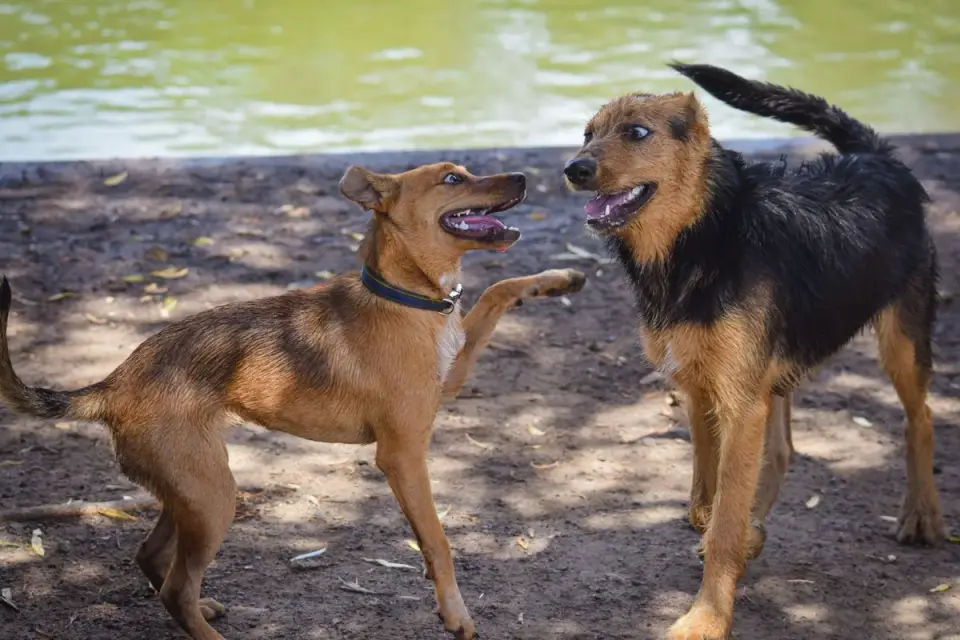
Good play has rhythm: chase, then a pause, then a role swap, then chase again. Bad play — the kind that turns into a fight — tends to be one-directional and relentless, with no pauses and no role reversal. If Duke is always the one doing the chasing and the other dog never gets a turn, or if the “wrestling” has stopped including any breaks, that’s worth interrupting before it escalates, not after.
One of the dogs I worked with, a nine-year-old Beagle named Otis, had started snapping at younger dogs mid-play — his owner assumed it was aggression developing out of nowhere. What was actually happening was arthritis: Otis had loved rough play for years, but by nine, a body-slam that used to be fun now hurt, and he had no other way to say so. We didn’t fix that with dog park etiquette. We fixed it by skipping the free-for-all play sessions and switching to structured, low-impact walks with one calm dog friend instead. The lesson I give owners from that case: not every dog park problem is a training problem. Sometimes the dog is telling you the format itself doesn’t fit him anymore, and the honest answer is to change the plan, not push through it.
Where nervous-system support fits, and where it doesn’t
For dogs whose park struggles come from genuine anxiety rather than simple over-excitement — the ones who pace, pant, or shut down rather than play — training and structure still have to come first. Nothing calms an anxious dog reliably if the environment itself keeps overwhelming him. But for dogs already in a solid training plan, some owners look at nutritional or herbal support to take the edge off before high-stimulation outings.
The evidence here is real but modest, and it’s worth being honest about what it does and doesn’t say. Chamomile has a long history in calming formulations, though a recent review notes that “for the remaining species, evidence is derived mainly from preclinical studies or traditional use” (Biomedicines) — meaning most of what we know about chamomile’s calming effect in dogs specifically is still extrapolated rather than directly proven. Ashwagandha has firmer human data behind it: a systematic review found that “ashwagandha has a moderate positive impact on stress reduction and cognitive performance” (Cureus) across multiple randomized trials, though that research is in people, not dogs. L-theanine’s evidence is narrower still — one review found a meaningful effect “on psychotic anxiety (SMD = 0.54; 400 mg/day for 8 weeks)” (Molecular Psychiatry), a specific human dose and population that doesn’t automatically translate to a dog at the park gate.
I tell owners this plainly: these ingredients may help support a calmer baseline in a dog who’s already getting the training and structure right. They are not a substitute for the entry routine, the recall practice, or recognizing when a dog needs a smaller, calmer environment instead of the busiest hour at the park.
What actually derails this process
The single most common mistake I see is owners treating the dog park as the training ground itself, rather than the place you graduate to once the skills are solid. Recall, impulse control, and body-language literacy need to be built somewhere lower-stakes first — a quiet yard, a friend’s fenced patio, a training class — and then tested at the park, not taught there for the first time. If your dog doesn’t reliably check in with you in your own backyard, the dog park is not where that skill will suddenly appear.
The second mistake is staying too long. Arousal that starts fine at minute ten can curdle by minute forty, especially for dogs who never learned to self-regulate during play. If Duke had a hard stop built into his visits — twenty minutes, then leash back on regardless of how good things looked — most of his park problems would have shrunk on their own. This overlaps in a lot of the same territory as barrier frustration, which looks similar to aggression but isn’t, and it’s worth reading that distinction if your dog reacts through the fence before you’re even inside.
What I’d actually tell you to do this week
By the third visit with a real entry routine — sit at the gate, wait for the softening, release on cue, recall every few minutes inside — Duke’s owner told me he finally looked “like the dog we have at home.” That’s the goal. Not a dog who never gets excited, but one whose excitement has a shape to it.
Start smaller than you think you need to. Practice the gate-sit and the recall somewhere boring first. Watch for the early stiffening before it becomes a stare. And if what you’re actually seeing isn’t over-excitement but a dog who won’t loosen up no matter what you try, it’s worth ruling out real fear before assuming it’s a behavior problem — that distinction matters, and it’s covered well in signs of true aggression and when to get professional help. Dogs who seem “fine” everywhere except the park are often telling you something specific about that environment, and the fix is almost always structure first, support second.
Frequently asked questions
How long should a first dog park visit last?
Keep it short — fifteen to twenty minutes is plenty for a dog who's still learning to self-regulate at the park. Ending on a calm note while your dog is still doing well teaches him more than staying until he's overtired ever will.
Is it normal for my dog to be perfect at home but wild at the dog park?
It's common, and it usually reflects arousal that built up on the way there rather than a different personality. A structured entry routine — sit, wait for a calm body, release on cue — closes most of that gap over a few visits.