Is Fetch Bad for a Growing Puppy's Joints?
Fetch isn't automatically harmful, but sprinting, skidding, and leaping can overload growing joints. Learn safer ways to play.
Fetch isn't bad for your puppy's joints by itself — how you throw it is what matters most.

On this page
Fetch isn’t bad for your puppy’s joints by itself — how you throw it is what matters most.
You throw the ball, your puppy lights up, and for five minutes everything feels perfect. Then you start wondering if those hard stops and wild turns are doing damage you can’t see yet.
I get that worry from owners every spring, and it’s a fair one. Growing joints are not just small adult joints. The ends of long bones are still soft, open growth plates turning to bone, with ligaments and muscle trying to keep up. What hurts a puppy is rarely distance. It is peak load — the full-speed sprint, the slam-on-the-brakes stop, the twisting leap for a ball thrown high over the head.
Picture a 5-month-old, 38-pound Golden Retriever mix in a fenced backyard in April. Her owner is throwing a tennis ball full length, 40 yards, 15 times in a row after work. By throw ten she is panting hard, skidding on wet grass to grab the ball, then popping straight up for the next launch. By day 10 of that routine she starts sitting out the last two throws and looks stiff getting up from her crate in the morning. Nothing is torn. She is just sore from repeated impact her conditioning cannot absorb yet. That pattern — long throws, slick footing, no endpoint — is the decision to change.
Why fetch loads joints differently than a walk
A walk spreads force evenly. Fetch concentrates it.
Think about the sequence: explosive start, top speed, hard deceleration, turn, grab, twist back to you. Each stop can load the shoulders, elbows, hips, and knees far more than trotting the same distance. Add a young dog with loose coordination and open growth plates, and you have more shear through tissue that is still maturing.
That does not mean you have to ban fetch. It means you have to manage the parts that spike load. Short, low rollers on grass beat long air balls on concrete. One or two calm retrieves beat fifteen frantic reps. Flat, non-slick footing beats hills, stairs, and wet decks.
If you want help calibrating normal activity, my guide on How Long Should a Dog’s Walk Be? lays out how to read fatigue and body condition on the move.
The version of fetch I would actually let a puppy play
Keep it boring on purpose. That is the whole trick.
Roll the ball 10 to 15 feet on grass or carpet. Ask for a sit or a pause before you release. Keep sessions to three to five minutes, then do something else — sniff walk, training, chew. Stop while your puppy still wants more. You are building muscle, coordination, and manners without asking soft tissue to absorb adult-dog forces.
Avoid the big three until growth slows and conditioning is solid: no high throws that invite vertical leaping, no full-field sprints with screeching stops, and no fetch on hardwood, concrete, or icy ground. A tired puppy that keeps chasing anyway is not proving fitness. Puppies will override soreness for a ball, so you have to be the brakes.
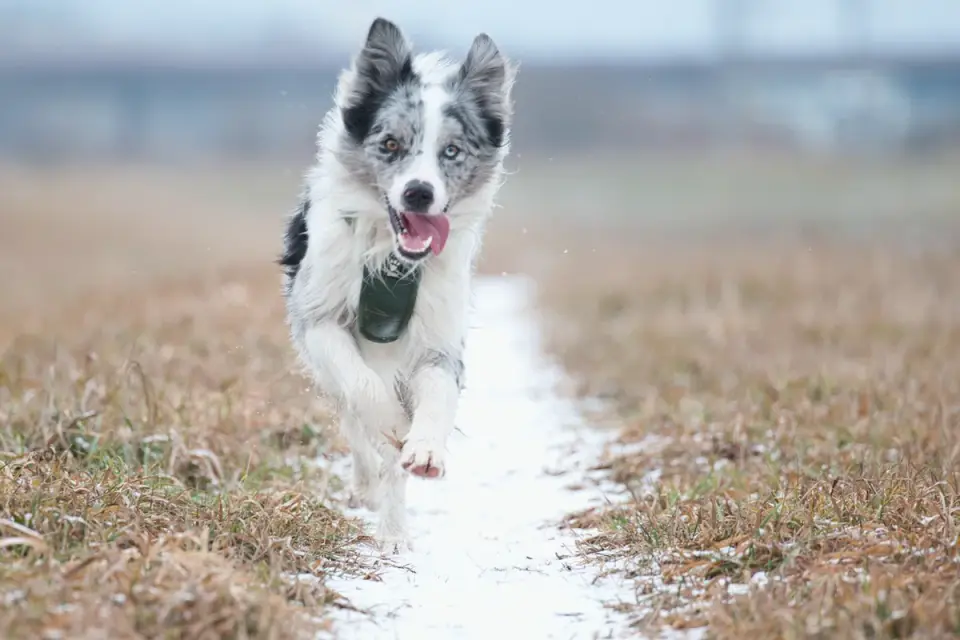
This is where a lot of owners get stuck. An 8-month-old, 52-pound Labrador owner told me fetch was the only thing that tired his dog, so he went bigger — 20-minute sessions at the soccer field, uphill throws, three weeks in with no rest days. The dog started bunny-hopping after hard stops and refused the last retrieve, then looked fine the next morning so they repeated it. That on-off lameness is classic overload: enough rest to feel better, not enough change to heal the pattern. We did not need more exercise. We needed less intense exercise, spread out, with the uphill launches cut entirely.
Shorter throws felt like a letdown at first. Within two weeks the limp after play was gone because the peak braking force was gone.
Food, weight, and what a supplement can realistically do
Diet and body condition move joint health first. A lean puppy with steady growth, balanced puppy food, and daily low-impact movement will do more for future mobility than any powder or chew.
That is the lens I use for supplements, too. I weigh what a supplement can realistically do for diet, mobility, and recovery, and I stay honest about where the evidence is thin. Glucosamine and chondroitin are among the most studied joint support ingredients for dogs, but studied does not mean proven to prevent injury from too much fetch.
Ground an integrative claim in the nutritional evidence and you get something modest and useful. In lab work, glucosamine has been shown to “prevent experimentally induced cartilage degradation in vitro,” reported in the Journal of Veterinary Medical Science, which tells us about cartilage biology, not that a chew lets a puppy play harder. Chondroitin “supports healthy synovial fluid homeostasis,” reported in Frontiers in Veterinary Science, which is about the joint environment, not repair of an overload injury. Green-lipped mussel work is earlier still — one analysis found that “BMO, GMO, and KO all alleviated paw swelling in rats and reduced serum levels of rheumatoid factor (RF), anti-cyclic citrullinated peptide (anti-CCP) antibody, and pro-inflammatory cytokines such as TNF-α and IL-17,” reported in Nutrients — interesting for inflammation pathways, not a reason to extend fetch.
The strongest counterargument I hear is fair: if those ingredients may help support normal joint structure, why not dose early and play hard anyway? Because no supplement changes physics. If the load stays too high, you are just paying for support while you keep creating the stress.
For more on that tradeoff, see Fetch vs. Structured Walks: Which Exercise Actually Serves Your Dog Better? and Common Dog Exercise Mistakes Owners Make (And What to Do Instead).
The edge case that changes the plan
Some puppies need a stricter rule for a while.
Take a 7-month-old, 64-pound large-breed pup with knobby wrists, a roly-poly gait, and a family worried about hips because the sire had dysplasia. At the park at six weeks in, he started shortcutting turns on his left hind and sitting with that leg kicked out after three long Frisbee chases. That is not a puppy to “condition through” fetch. That is a puppy to pause high-impact play, keep walks flat and sniffy, keep weight lean, and call your veterinarian for a gait check and growth assessment.
Breed risk, fast growth, prior limping, or pain that lasts more than a day changes everything. Normal tired means flopping with even breathing and bouncing back after a nap. Concerning means limping, skipping steps, stiffness the next morning, or wanting to quit a game they usually love.
You do not need to be perfect. Roll it, keep it short, quit early, and let the rest of the day do the work.
Frequently asked questions
How much fetch can a 4- to 6-month-old puppy play?
Think minutes, not throws. Three to five minutes of short ground rollers on grass with rest breaks, stopping before heavy panting or sloppy turns.
What are signs fetch was too much?
Limping, skipping a leg, stiffness the next morning, sitting out retrieves, or soreness getting up after a nap. If lameness lasts more than 24 hours, call your veterinarian.
Should I throw the ball uphill or use stairs to tire my puppy?
No. Hills, stairs, and high leaps raise peak joint load. Tire a puppy with sniff walks, training, and short flat play instead.
Sources
- Synovial fluid homeostasis study — Frontiers in Veterinary Science
- Cartilage degradation in vitro study — Journal of Veterinary Medical Science
- Marine oil joint inflammation study — Nutrients