Why Does My Dog Chase and Try to Catch Small Animals?
A vet explains the predatory sequence behind chasing squirrels, rabbits, and cats, why it's rarely about aggression, and how to manage it safely.
Most dogs that chase and try to catch small animals aren't being aggressive — they're running an ancient hunting script.
On this page
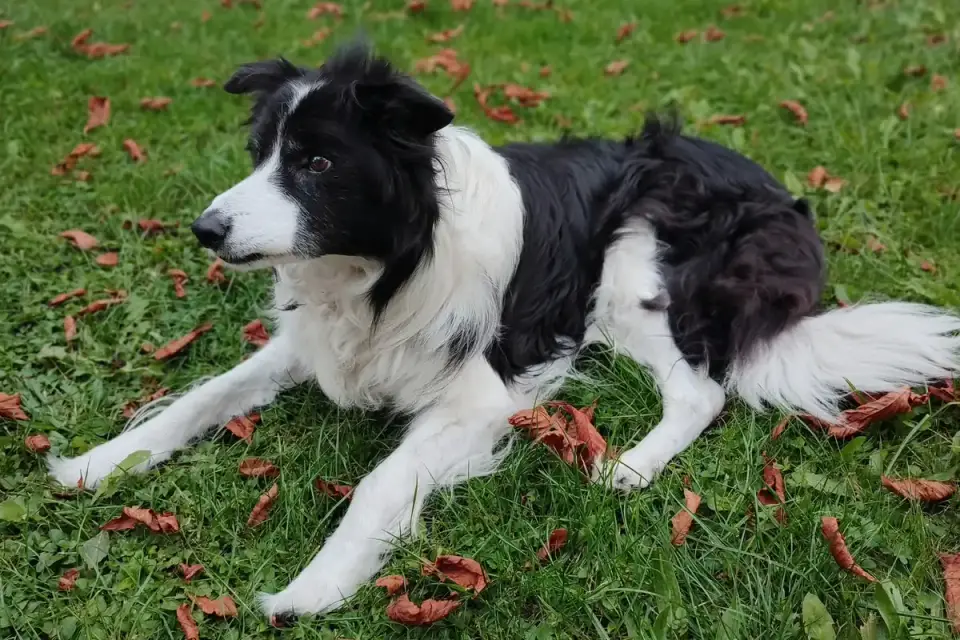
The first time I saw it up close in a client’s living room, not a field, was with a two-year-old Border Collie mix named Scout. His owner had a rescued rabbit in a floor pen, and Scout would lie at the edge of it for twenty minutes at a stretch, body low, eyes locked, not moving except for the occasional twitch of his ears. The second the rabbit shifted, Scout’s whole body would coil tighter. He never lunged in that room — his owner had done the management work — but I watched the same eye, the same stillness, the same fixed stare I see in dogs bolting after squirrels on a walk. That stillness is the tell. It’s not disobedience. It’s the front end of a hunting sequence that’s been wired into dogs for thousands of generations, and understanding where it starts is what actually helps owners manage it.
The predatory sequence, piece by piece
Chasing a squirrel, a rabbit, a cat, or even a fast-moving toddler isn’t one behavior — it’s a chain: orient, stalk, chase, grab-bite, kill-bite, dissect, consume. Domestic dogs retain fragments of this sequence in different proportions depending on breed history. A Border Collie or herding-type dog tends to have an exaggerated eye-stalk-chase component with the grab and kill portions bred down or absent, which is why herding looks so much like hunting without the ending. A terrier bred for vermin work carries a stronger chase-grab-kill chain intact. A sighthound is almost pure orient-and-chase, built for speed over a fixed distance rather than a prolonged stalk. None of this is misbehavior in the obedience sense. It’s motor patterning that fires independently of whether the dog is otherwise well trained, which is why a dog who sits and stays reliably in the kitchen can turn into a different animal the instant a rabbit breaks cover.
Why the trigger is movement, not the animal itself
What actually flips the switch is rapid, erratic movement more than the identity of the thing moving. Dogs with strong prey drive will often chase a blown leaf, a bicycle, a jogger, or a skateboard with the same intensity as a squirrel, because the visual trigger is speed and unpredictability, not “small furry animal.” This matters practically: a dog that chases wildlife on walks is very likely to also chase runners, cars, or kids on scooters, and the underlying management plan needs to account for all of it, not just the animal version.
Building a plan that respects the instinct instead of fighting it
You cannot train prey drive out of a dog, and I’d gently push back on anyone who promises you can. What you can do is change what happens before the chase starts and give the dog a job to do instead of a target to run down. That starts with management: a long line instead of an off-leash park in areas with wildlife, physical barriers around chickens or rabbits, and never assuming a “good recall” holds up against a fleeing rabbit, because recall is a learned behavior competing against an instinctual one, and instinct usually wins at the moment it matters most.
From there, the more durable fix is redirecting the sequence itself. Flirt poles, structured tug, and scent work give a dog the orient-stalk-chase-grab experience in a context you control, which for many dogs measurably reduces the pressure to find that outlet elsewhere. I’ve had good results recommending 10–15 minutes of structured chase-and-grab play before a walk in a wildlife-heavy area — it doesn’t eliminate the instinct, but it takes the edge off enough that training cues actually get heard.
For dogs whose baseline arousal runs high — the ones who seem to be scanning for movement even on a calm walk — the underlying stress and arousal state is worth addressing alongside the training. This is where structure/function support, not a training shortcut, can play a role. Biomedicines: Chamomile has a long history in traditional herbal care for supporting relaxation, though for dogs specifically the evidence is derived mainly from preclinical studies or traditional use rather than large canine trials. Cureus: KSM-66 Ashwagandha has more human clinical weight behind it: a systematic review of multiple randomized trials concluded it has a moderate positive impact on stress reduction and cognitive performance, though that evidence base is human, not canine, and shouldn’t be read as a promise for dogs. Molecular Psychiatry: L-theanine, an amino acid found in tea, has calming research support in humans too — one trial on psychotic anxiety found a moderate effect at 400 mg/day over 8 weeks — but again, that’s a human dose and a human population, not a canine one. I mention these because owners ask about them constantly, and I’d rather give an honest, bounded answer than let a product label do the talking. None of them replace the management and redirection work above; they’re a possible add-on for a genuinely anxious or over-aroused dog, not a fix for prey drive itself, which isn’t an anxiety problem to begin with.
I think of a Labrador-mix client, Duke, four years old, sixty-two pounds, whose owner called me after he’d nearly pulled her off her feet chasing a rabbit across a frost-covered yard in February. What struck me wasn’t the chase — it was that Duke had been sleeping poorly for two weeks before that, pacing at night, which told me his baseline arousal was already elevated before the rabbit ever showed up. We didn’t treat that as a training failure. We treated it as two separate problems stacking on top of each other: a dog whose sleep and stress baseline needed attention, sitting on top of an instinct that was never going away. Six weeks of more structured exercise, a predictable evening routine, and addressing the sleep disruption directly brought his reactivity on walks down noticeably, even though his interest in movement never disappeared and was never going to.
This overlaps with how owners read a dog’s warning signals more broadly — the same stillness and fixed stare that precedes a chase can look similar to, but is functionally different from, the tension you’d see in growling when petted or the freeze-and-hard-stare of whale eye. Learning to tell a predatory stare from a defensive one is one of the more useful skills an owner can build, because the intervention is completely different — one calls for redirection and management, the other calls for giving the dog space.
What tends to derail this
The most common mistake I see is punishing the chase after it’s already started. By the time a dog is mid-sprint after a squirrel, the sympathetic nervous system has fully taken over and the dog is not in a state to process a correction — it just adds stress on top of an already aroused animal. The better intervention point is earlier, at the orient-and-stalk stage, before the chase itself begins, which is exactly why teaching a dog to disengage from movement at a distance (rather than trying to call them off mid-chase) is the actual skill worth building. It’s also worth separating true prey drive from barrier frustration, which can look similar at a fence line but stems from thwarted access rather than a hunting sequence — the training response differs for each.
A short paragraph, because this deserves to stand alone: prey drive is not a training failure, and it is not aggression toward the dog’s own household or people. It’s a separate behavioral system entirely.
Where this actually lands
Owners often ask me if their dog can be “cured” of chasing. I don’t frame it that way, and I think it does a disservice to set that expectation. The realistic goal is a dog who can be redirected before the chase fully launches, who gets a structured, sanctioned outlet for the instinct on a regular basis, and whose overall arousal baseline is being managed through exercise, routine, and — for some dogs — targeted calming support alongside the behavior work, not instead of it. I’d rather tell an owner honestly that this is management over a dog’s lifetime than sell them on a training plan that promises the instinct disappears, because it doesn’t, and pretending otherwise sets everyone up to be disappointed by month three.
Frequently asked questions
Is chasing small animals a sign of aggression in my dog?
Usually not. Chasing is typically part of the predatory sequence — orient, stalk, chase — rather than the fear- or conflict-driven behavior seen in true aggression. The stillness and fixed stare that precede a chase can look tense, but they serve a different function than a defensive warning signal.
Can training eliminate prey drive completely?
No. Prey drive is an instinctual motor pattern, not a learned behavior, so it can't be trained away entirely. What training and management can do is redirect the instinct into controlled outlets and teach a dog to disengage before a chase fully launches.
Should I be worried if my dog chases things other than animals, like bikes or joggers?
It's common, and it points to the same underlying trigger — fast, erratic movement — rather than a separate problem. A dog that chases wildlife will often chase these too, so a management plan should account for all moving triggers, not just animals.
Sources
- Chamomile in preclinical and traditional anxiety research — Biomedicines
- Ashwagandha (KSM-66) systematic review of stress reduction RCTs — Cureus
- L-theanine anxiety trial evidence — Molecular Psychiatry